CBIRD Research Day
March 31-April 2, 2027
Ohio Union Performance Hall
Registration has not opened.
Check out the image below to see the 2026 Research Day lineup!
Registration has not opened.
Check out the image below to see the 2026 Research Day lineup!
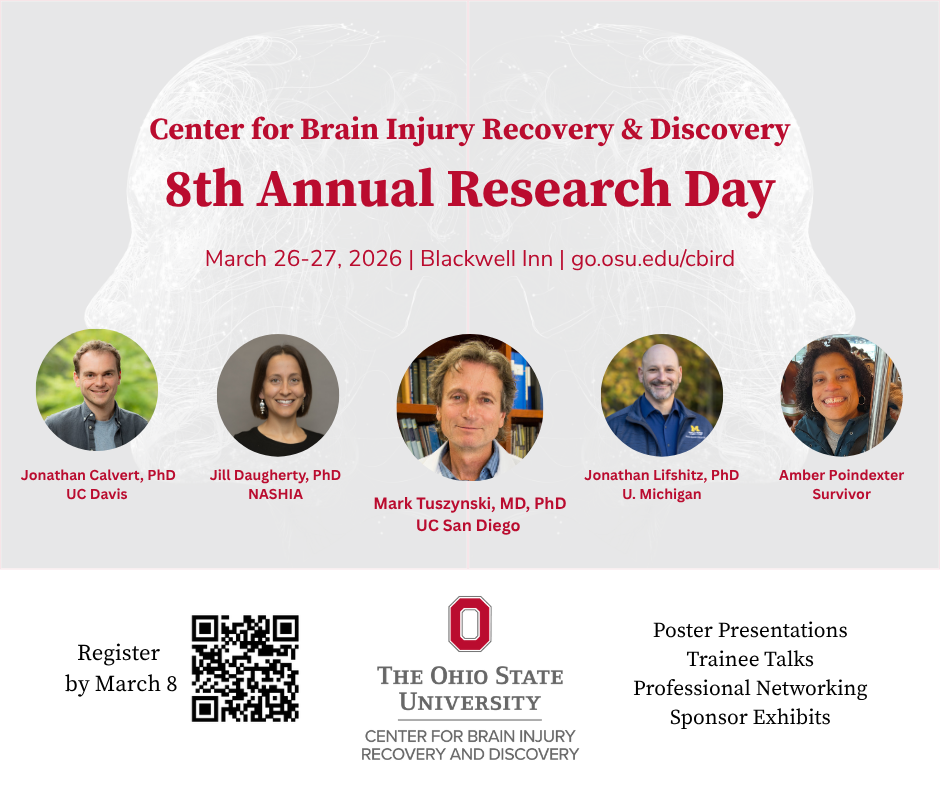

The day of schedule will be released at a later date.
The abstract submission due date will be released soon!
Abstracts: Abstracts must include a maximum 400-word narrative in 11-point Arial font with no figures or images, plus a header with 3 lines: a) your full abstract title (first letters capitalized); b) all authors with your (presenter's) name in bold; and c) list of department/unit affiliations. Please submit your abstract as a .docx file with filename as follows: LASTNAME.FIRSTNAME.MENTORLASTNAME.docx
Posters: Posters will be mounted on foam boards, sized 4ft x 4ft. We suggest poster sizes of 30 in. x 40 in. or 36 in. x 48 in. (landscape orientation).
Research Day Faculty Committee: TBD
"A Translational Program of Neural Stem Cells for Spinal Cord Injury"
Mark Tuszynski, MD, PhD | Distinguished Professor of Neurosciences & Director, Translational Science Institute - University of California, San Diego
"Toward Precision Neurorehabilitation for Human Sensorimotor Recovery"
Jonathan Calvert, PhD | Assistant Professor of Neurological Surgery - University of California, Davis
"The Unfinished Public Health Story of Brain Injury"
Jill Daugherty, PhD | Director, Innovation Center - National Association of State Head Injury Administrators (NASHIA)
"Watching the Brain Heal: Time-Lapse Pathodynamics and the Promise of Psychedelic Medicine"
Jonathan Lifshitz, PhD | Associate Director of Education & Engagement - University of Michigan, Concussion Center
Amber Poindexter | Senior Operations Analyst, OSU Board of Trustees
"Moderate Traumatic Brain Injury to the Prefrontal Cortex Remodels Corticostriatal Circuits: A Role for Microglia and Neuroinflammation in Impulsivity"
Erskine Chu, PhD | Postdoctoral Researcher, Neuroscience
PI: Cole Vonder Haar, PhD
"Orthographic Cueing in Aphasia Therapy: For Whom and Why?"
Natalie Freitag | Graduate Student, Speech & Hearing Sciences
PI: Stacy Harnish, PhD, CCC-SLP
"Linear and Non-Linear Associations Between Cardiorespiratory Fitness and fMRI Activation in Episodic Memory Across the Adult Lifespan"
Inola Howe | Graduate Student, Psychology
PI: Scott Hayes, PhD
"Polarity and Dose-Dependent Effects of Spinal Direct Current Stimulation on Diaphragm Activity After Cervical Spinal Cord Injury in Rats"
Matthew Rease | Research Assistant, Neuroscience
PI: Sabhya Rana, PhD
"Microglia Contribute to Early Life Stress and Pediatric Traumatic Brain Injury-Related Behavioral Effects in Male and Female Rats"
Marissa Smail, PhD | Postdoctoral Researcher, Psychology
PI: Kathryn Lenz, PhD
"WFS1 Deficiency Exacerbates Tauopathy-Relevant Pathology in Novel Humanized H1.MAPT model"
Jia Kang Xie | Undergraduate Student, Neuroscience
PI: Hongjun (Harry) Fu, PhD
Discovery: Marie-Amandine Bonte | Fu Lab | Ectodermal-neural cortex 1 and tau clearance in Alzheimer’s disease
Recovery: Alexa Plotkin | Quatman-Yates Lab | Breaking Barriers: Pilot Testing an SBIR-Supported Online Physical Activity Platform for Brain Injury Survivors
Systems: Sarah Henn | S. Hayes Lab | Relative Importance of Fitness Domains on Visual Episodic Memory Performance
Discovery: Tae Yeon Kim | Fu Lab | Excitatory Neuronal PLCG2 Regulates Tau Pathology, Gliosis, and Cell Death via Alteration of the Autophagy-Lysosomal Pathway
Assessment: M. Shifatul Islam | Kiourti Lab | Overcoming Limitations of Microwave Tomography Imaging for Stroke Detection and Monitoring
Recovery: Natalie Freitag | Harnish Lab | Orthographic Cueing in Aphasia Therapy: For Whom and Why?
Systems: Inola Howe | S. Hayes Lab | Linear and non-linear associations between cardiorespiratory fitness and fMRI activation in episodic memory across the adult lifespan
Discovery: Sohan Jayasekera | Gao Lab | TLR4 Signaling Links Peripheral Infection to TREM2 Shedding and Microglial Dysfunction in Alzheimer’s Disease
Assessment: Kailash Sastry | Rana Lab | An Automated Deep Learning Framework for Objective Segmentation and Quantification of Diaphragm EMG Across Physiological States
Recovery: Dhruva Vanakeri | Rana Lab | Non-invasive spinal stimulation improves diaphragm activation during challenged breathing in intact and spinally injured rats
Systems: Jia Kang Xie | Fu Lab | WFS1 deficiency exacerbates tauopathy-relevant pathology in novel humanized H1.MAPT model
Alexa Benear, MBA | Project Manager, Center for Brain Injury Recovery & Discovery
Jonathan Godbout, PhD | Professor, Neuroscience; Faculty Director, Center for Brain Injury Recovery & Discovery
Kedar Hiremath, MBA, MPH | Associate Director, Center for Brain Injury Recovery & Discovery
Andrew Sas, MD, PhD | Physician & Assistant Professor, Neurology
Ceren Yarar-Fisher, PhD | Associate Professor & Vice Chair of Research, Physical Medicine & Rehabilitation; Director of Clinical Research, Belford Center for Spinal Cord Injury
Phillip Yuhas, OD, PhD | Optometrist & Assistant Professor, Optometry
Coming Soon!
Coming Soon!